

NEWS CENTER
—
NEWS CENTER
—
Custom Stainless Steel Tumbler Manufacturer Guide: From Inquiry to Delivery
2026-03-29 15:25:35
Click:
“
If you’ve ever sourced OEM ODM drinkware before, you know the frustrating part i
”
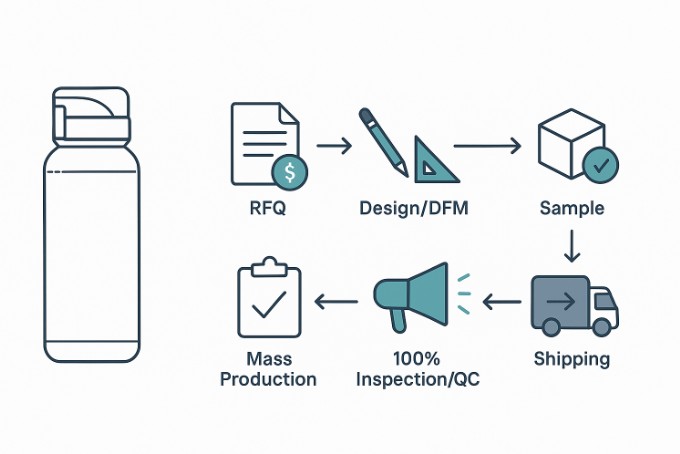
If you’ve ever sourced OEM ODM drinkware before, you know the frustrating part isn’t picking a bottle shape. It’s uncertainty.
Will the quote match the final cost? Will the first sample look right but fail a leak test? Will production slip after you approve everything?
This guide breaks down the water bottle OEM process—from your first inquiry to the cartons leaving the factory—so you can run a clean RFQ, control risk, and keep your timeline predictable.
OEM vs. ODM (in one minute)
Before we go step-by-step, it helps to define two terms you’ll see in every supplier email:
- OEM (Original Equipment Manufacturer): you provide the design (or a very specific tech pack), and the factory manufactures to your requirements.
- ODM (Original Design Manufacturer): you start from a factory’s existing design, then customize things like color, logo, finish, and packaging.
A practical explanation of how brands use OEM vs. ODM in drinkware is covered in Haers’ OEM vs ODM guide for drinkware brands (2025).
Key Takeaway: If you need speed and lower up-front cost, ODM can be a smart starting point. If you need a signature design and long-term exclusivity, OEM is the usual path.
The end-to-end process with a custom stainless steel tumbler manufacturer
Think of a custom insulated water bottle or tumbler project as a series of gates. Each gate has inputs, outputs, and a “no surprises” checkpoint.
1) Inquiry: align on the basics (before you send files)
Your first message should be short and specific. The goal isn’t to “get a price.” It’s to confirm the supplier can build what you want.
At minimum, state:
- Product type (vacuum insulated bottle, coffee tumbler, sports bottle)
- Target market (retail, corporate gifts, promotional)
- Expected annual volume and first order quantity range
- Your target launch date
If the supplier immediately pushes for a deposit or avoids technical questions, treat that as a signal—not a shortcut.
2) RFQ: convert your idea into something quotable
An RFQ (Request for Quotation) is a structured request that lets suppliers price the same requirements so you can compare responses fairly.
Procurement teams tend to use RFQs when specs are defined and the goal is a comparable quote, not an open-ended proposal. That’s why a well-built RFQ saves time and prevents “quote drift” later.
If you need a clean definition and a simple RFQ workflow, see Sievo’s “RFQ process in 6 steps” (2025) and Lightsource.ai’s guide to RFQs in direct materials (2025).
What to include in an RFQ for custom drinkware
You don’t need a 40-page spec book. But you do need enough detail to prevent assumptions.
Include:
- Drawings/files
- Material and performance requirements
- Customization scope
- Commercial inputs
For a manufacturing-first view of how to structure RFQs so quotes stay comparable, SourcingIQ’s RFQ best practices for manufacturers (2026) is a solid reference.
3) DFM review: the “save money before you spend money” step
DFM (Design for Manufacturability) is where a factory checks whether your design can be produced consistently at scale.
This is where good suppliers earn their keep. They should flag:
- risk points in lid sealing and thread compatibility
- finish choices that scratch easily in transit
- tolerances that are unrealistic for the forming/welding method
- design details that require costly tooling or slow down cycle time
If you’re early-stage, ask for DFM feedback even on ODM projects—because a “catalog model” still has constraints once you add your own lid, coating, or packaging.
4) Sampling: check fit, feel, and brand details
A sample is not just “Does it look right?” It’s:
- Does it seal and open the way users expect?
- Does it fit standard cup holders (if that matters for your market)?
- Does the coating survive rubbing and drop tests?
- Does the logo look crisp at your chosen size?
Your job is to define what you’re approving:
- Appearance approval (color/finish/logo/packaging)
- Functional approval (leak, temperature retention method, durability)
Don’t approve mass production if only appearance is confirmed.
5) Tooling (when applicable): where timelines can stretch
Not every project needs new tooling.
- ODM: often uses existing tooling for the bottle body; your costs show up in decoration and packaging.
- OEM: may require new dies or molds, especially for unique shapes, lids, or accessories.
At this stage, clarify two things:
- Who owns the tooling (and what happens if you switch suppliers)?
- What the revision loop looks like if the first “off-tool” sample needs changes?
6) Pre-production confirmation: lock the “golden sample”
Before mass production, align on a “golden sample” (or approved reference) that becomes the physical standard.
This prevents the most common conflict in sourcing: “We produced what you approved” vs. “This isn’t what we expected.”
7) Mass production: where consistency matters more than speed
For vacuum insulated drinkware, consistency is everything. Small variations in forming, welding, cleaning, or sealing can show up as:
- leaks
- paint defects
- odor issues
- insulation performance variation
This is where a factory’s automation, process discipline, and inspection coverage matter more than a one-time perfect sample.
A quick factory-process walkthrough (video)
To make the middle stages easier to visualize (forming → welding → vacuuming → finishing), here’s a short factory-process example video:https://studio.youtube.com/channel/UCR_9MwCJx91prbzLq3FcaIw/videos/upload?filter=%5B%5D&sort=%7B%22columnType%22%3A%22date%22%2C%22sortOrder%22%3A%22DESCENDING%22%7D
8) Quality control: what buyers can actually verify
Many suppliers say “strict QC.” A better question is: How do you measure it?
Two concepts are worth knowing:
AQL and ISO 2859-1 (acceptance sampling)
AQL (Acceptable Quality Limit) is a statistical sampling method used to decide whether a production lot passes inspection based on defects found in a sample.
It’s commonly tied to ISO 2859-1, the international standard for acceptance sampling plans. See ISO’s ISO 2859-1:2026 standard overview and Testcoo’s guide to ISO 2859 sampling (2024) for a buyer-friendly explanation.
PSI (Pre-Shipment Inspection)
A pre-shipment inspection (PSI) is typically performed when production is largely complete, often described as 80–100% finished, to verify quantity, workmanship, packaging, and key performance checks.
For a process overview, see QIMA’s pre-shipment inspection procedure (2025).
Pro Tip: In your RFQ, specify defect categories (critical/major/minor), AQL levels, and whether you require PSI before shipment. “No AQL specified” usually means “no shared definition of pass/fail.”
9) Packing and shipping: don’t treat it as an afterthought
A bottle that passes function can still fail in the real world if:
- the coating scuffs in the master carton
- the lid cracks because the insert doesn’t protect the threads
- barcodes or carton marks don’t match your warehouse system
Confirm:
- packing drop test expectation (even a basic one)
- carton count, pallet rules, and shipping marks
- what “ready to ship” means (photos, packing list, inspection report)
What Hengjun’s one-stop workflow means (without the fluff)
Hengjun Industry & Trade positions itself as a one-stop OEM/ODM partner for stainless steel vacuum insulated drinkware—covering design support, sampling, mass production, and quality inspection.
If you’re evaluating Hengjun specifically, start at the official site: Hengjun Industry & Trade.
Because this is an awareness-stage guide, keep your early questions process-focused:
- What do you need to quote accurately (files, specs, test methods)?
- What are your sample approval gates before mass production?
- What does “100% inspection” cover (which checks are 100%, which are sampled)?
- What material grades do you recommend (e.g., 316 for certain use cases) and why?
Common pitfalls (and how to avoid them)
Pitfall 1: Sending a “concept” and expecting a firm quote
Fix: send a minimum tech pack. If you can’t, ask for a budgetary range and the assumptions behind it.
Pitfall 2: Approving a sample without an acceptance standard
Fix: define what “pass” means (appearance + function + packaging).
Pitfall 3: Treating QC as a slogan
Fix: specify AQL/PSI, defect categories, and the inspection report format.
Pitfall 4: Forgetting packaging is part of the product
Fix: approve packaging mockups and define carton requirements early.
Next steps (low-commitment)
If you want a faster, cleaner quoting round, build your RFQ around the checklist above and ask suppliers to respond in the same template.
If you’re speaking with Hengjun, you can also request a quick feasibility review of your drawings and customization plan so you can catch design and QC risks before you spend on tooling.
FAQ
What’s the difference between OEM and ODM in drinkware?
OEM generally means you bring the design and the factory manufactures it. ODM means you start from a factory’s existing model and customize colors, branding, and packaging. A practical overview is in Haers’ OEM vs ODM guide for drinkware brands (2025).
What does AQL mean for my order?
AQL is a sampling standard that defines how many units are inspected and what defect counts trigger accept/reject decisions for a batch. It’s commonly tied to ISO 2859-1. See ISO’s ISO 2859-1:2026 standard overview.
When should I schedule a pre-shipment inspection (PSI)?
PSI is typically done when production is nearly complete, so issues can be fixed before shipment. For a process overview, see QIMA’s pre-shipment inspection procedure (2025).
Do I need a 3D file to get a quote?
Not always, but it helps. A clear 2D drawing with critical dimensions and a defined customization scope is often enough for a comparable RFQ.
How many samples should I approve?
At least one appearance sample and one functional sample (which may be the same unit if your test plan is clear). The key is defining what you’re approving.
Related news
-

top Reco Custom Stainless Steel Tumbler Manufacturer Guide: From Inquiry to Delivery
If you’ve ever sourced OEM ODM drinkware before, you know the frustrating part i
-
top Reco About Us - 15 Years of Dedication to Thermos Manufacturing, A Powerhouse Factory at the Source
Professional insulated bottle manufacturer with 15+ years of OEM/ODM expertise. ISO9001 certified, 500,000 units monthly capacity. 24-hour heat retention, 316 stainless steel. Trusted partner for global brands seeking custom solutions. Inquire for bulk orders.
-
Top 10 Cost-Effective Vacuum Flasks Multi-Dimensional Review | Pros & Cons of FXgonne, Xiao Guan Cha, SOYES, Cooker King & aisheer, Pick Heat-Insulated, Durable & Budget-Friendly Flasks Without Regret
I. Current Market of Vacuum Flasks: Hidden Safety Risks Behind GrowthDriven by r
-
A Complete Guide to Sourcing Custom Thermoses from Yongkang, China
Yongkang, known as the “Hometown of Hardware in China”, is the global epicenter for stainless steel thermos production. Home to thousands of specialized factories, including Yongkang Hengjun Industry & Trade Co., Ltd., this city delivers unrivaled expertise in custom thermos manufacturing—from precision engineering to eco-friendly production and flexible OEM/ODM solutions.
-
Reco Limited Edition Gradient-Color Insulated Cup Now Available
Hengjun Industrial & Trading has launched a limited-edition gradient-color insulated cup. Crafted from 316 stainless steel, this new product delivers 24-hour long-lasting insulation and targets young, fashion-conscious consumers. Pre-orders are now open on our official website. B2B corporate clients can enjoy customization services with a minimum order quantity of 500 units.
New Product Launch -
Last month at the Canton Fair, we had 73 walk-ins. Collected 61 business cards.




Whatsapp:+8615258943755
Contact:+8615258943755
Address: No. 55, Building 2, Lane 118, Yingbin Avenue, Shiya Lower Village, Gushan Town, Yongkang City, Jinhua City, Zhejiang Province
 YouTube
 instagram
 Facebook
 whatsapp